
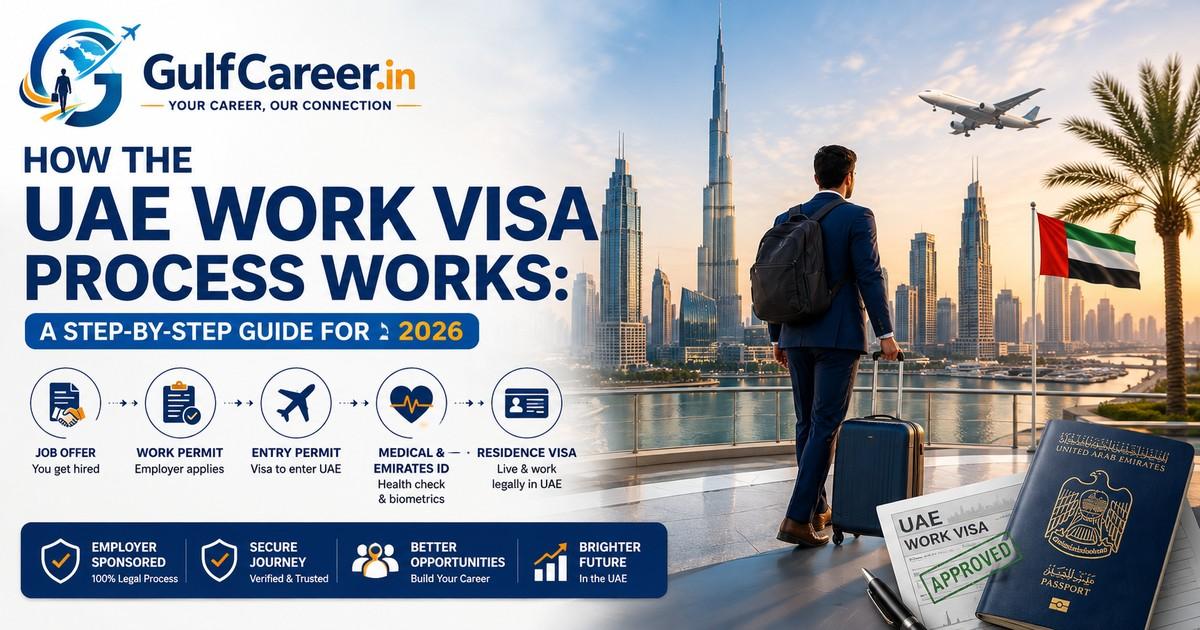
How the UAE Work Visa Process Works: A Step-by-Step Guide for 2026
By GulfCareer.in · 14 Aug 2026
Introduction
The United Arab Emirates remains one of the most popular destinations for professionals from India, the wider subcontinent, and around the world. Tax-free salaries, world-class infrastructure, and demand across sectors from construction to healthcare to technology continue to draw hundreds of thousands of new workers every year.
But for many first-time applicants, the visa process feels confusing. Who applies for what? How long does it take? What does the employer handle, and what do you handle yourself? This guide walks through the process from start to finish in plain language, so you know what to expect at each stage.
A quick but important note before we begin: UAE immigration rules, fees, and processing times change from time to time, and the exact process can vary depending on the emirate, your profession, and whether you are working on the mainland or in a free zone. Treat this as a general roadmap, and always confirm the current requirements with your employer and official UAE government sources before making any decisions.
Who sponsors your work visa?
The most important thing to understand about working in the UAE is this: you cannot simply apply for a work visa on your own. A UAE work visa is employer-sponsored. This means a licensed UAE company must offer you a job and then sponsor your visa through the relevant authorities.
In practice, this is good news for job seekers. Most of the heavy paperwork is handled by your employer's Public Relations Officer (PRO) or their HR department. Your main job is to secure the offer, provide accurate documents, and complete the required medical and biometric steps once you arrive or as instructed.
Step 1: Secure a genuine job offer
Everything starts with a legitimate job offer from a UAE-based employer. This is where a platform like GulfCareer.in fits in — helping you find and apply to real vacancies across the Gulf.
Before accepting any offer, verify that the company is genuine and licensed. Be cautious of any "agent" who asks you to pay large sums for a guaranteed visa or job — legitimate employers do not charge candidates for a job offer, and visa costs are typically borne by the employer for most positions. If something feels off, slow down and check.
Once you accept an offer, you will usually sign an employment offer letter outlining your salary, role, benefits, and terms.
Step 2: The employer applies for your work permit
With the offer in place, your employer applies to the UAE Ministry of Human Resources and Emiratisation (MOHRE) for a work permit, sometimes still referred to as a labour card or work authorisation. For free zone jobs, the relevant free zone authority handles this instead of MOHRE.
At this stage the employer typically needs copies of your passport, passport-sized photographs, your signed offer, and often your educational certificates — which may need to be attested (see Step 5). The authorities review the application against quota and eligibility rules.
Step 3: The entry permit
Once the work permit is approved, an entry permit (sometimes called a pink visa or employment entry visa) is issued. This is the document that legally allows you to enter the UAE for the purpose of employment.
If you are applying from your home country, this entry permit is what you travel on. It is usually valid for a set number of days and single or multiple entry. If you are already inside the UAE on another status, a status adjustment may be possible without leaving the country, depending on the rules that apply to your case.
Step 4: Arrival, medical test, and Emirates ID
After you arrive in the UAE on your entry permit, several steps happen in relatively quick succession:
Medical fitness test. You undergo a mandatory medical examination at an approved government health centre, which typically includes a blood test and a chest X-ray to screen for certain communicable diseases. Passing this is a requirement for the residence visa.
Emirates ID and biometrics. You apply for your Emirates ID, the national identity card that every resident needs. This involves having your biometrics (fingerprints and photo) captured at an authorised centre.
Medical insurance. Health insurance is mandatory for residents, and your employer generally arranges a policy as part of your package.
Step 5: Document attestation (do this early)
One step that catches many people off guard is certificate attestation. For many skilled roles — especially in education, healthcare, and engineering — your educational degrees and sometimes professional certificates must be officially attested to be recognised in the UAE.
Attestation usually involves several layers: verification in your home country (for example, by the relevant state authority and the Ministry of External Affairs in India), followed by attestation at the UAE Embassy, and finally by the UAE Ministry of Foreign Affairs after arrival.
Because attestation can take time, it is wise to begin this process as early as possible — ideally as soon as you start seriously job-hunting, rather than waiting until you have an offer in hand.
Step 6: The residence visa
Once your medical test is cleared and your Emirates ID is being processed, your employer completes the final step: stamping the residence visa into your passport (or, increasingly, issuing it in digital form). This is what makes you a legal resident of the UAE and is typically linked to your employment.
With your residence visa in place, you can open a bank account, rent accommodation, get a local SIM, and — in many cases — sponsor eligible family members to join you, subject to salary and other conditions.
How long does the whole process take?
There is no single fixed answer, because it depends on the emirate, your profession, the completeness of your documents, and current processing volumes. As a rough guide, once you have accepted an offer and your documents are in order, the core visa steps often take a few weeks. Delays most commonly come from incomplete paperwork or attestation that was not started early enough — which is exactly why preparing your documents in advance matters so much.
Common mistakes to avoid
Paying an agent for a "guaranteed" visa. Legitimate jobs do not require you to pay large fees for the visa itself. Be very cautious of anyone who does.
Starting attestation too late. Begin certificate attestation early; it is one of the slowest parts of the whole journey.
Providing inconsistent documents. Make sure your name, spelling, and details match exactly across your passport, certificates, and application forms.
Not reading your contract carefully. Understand your salary, benefits, notice period, and what happens to your visa if you change jobs.
Assuming rules never change. Always confirm current requirements before you act.
A note on other Gulf countries
While this guide focuses on the UAE, the broader pattern — employer sponsorship, an entry permit, a medical test, biometrics, and a residence permit — is similar across other Gulf Cooperation Council countries such as Saudi Arabia, Qatar, Oman, Kuwait, and Bahrain. The specific authorities, documents, and terms differ in each country, so always check the requirements for the specific country you are moving to. We cover Gulf-wide vacancies at GulfCareer.in to help you explore your options.
Final thoughts
The UAE work visa process can feel daunting at first, but it follows a logical sequence, and most of the official steps are handled by your employer once you have a genuine offer. Your part is to find the right opportunity, prepare accurate and attested documents early, and understand each stage so nothing takes you by surprise.
Ready to take the first step? Browse the latest verified vacancies across the UAE and the wider Gulf on GulfCareer.in — your career, our connection.
Disclaimer: This article is provided for general informational purposes only and does not constitute legal or immigration advice. UAE visa rules, fees, and procedures are subject to change and can vary by individual circumstance, emirate, and employer. Always verify current requirements through your employer and official UAE government sources before making decisions.